


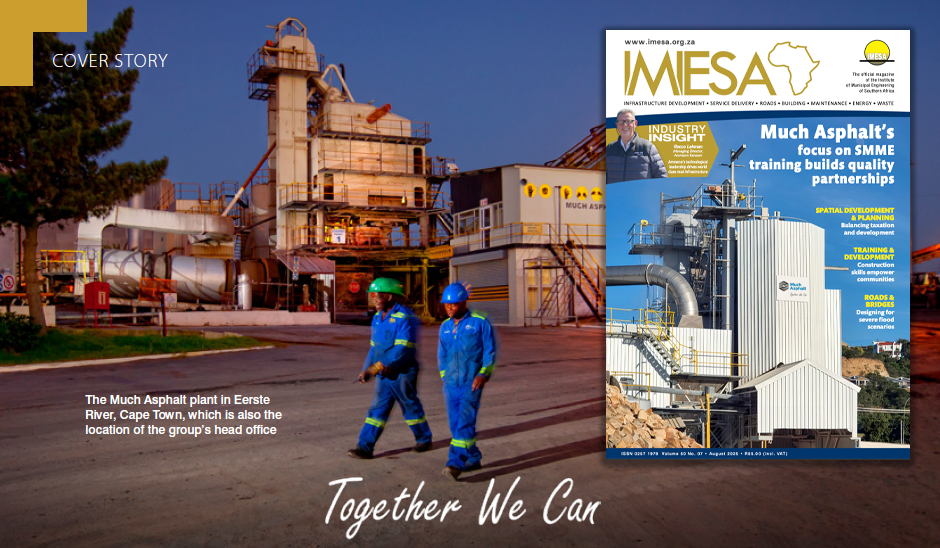
IMIESA Article Nov / Dec 2025 | Read full edition here
[Full text from article] PAVING THE WAY FOR RESILIENT AND SUSTAINABLE ROADS.
“In the evolving landscape of road construction and safety, the success stories lie right beneath our feet – quite literally,” says Michelle Lewis, KwaZulu-Natal Regional Technical Manager at Much Asphalt.
One of the most promising developments in modern pavement technology is Bitumen Rubber Asphalt Open Grade (BRAOG), a material that blends engineering innovation with environmental awareness. “Being part of the first BRAOG project in KZN is an honour and a privilege,” Lewis adds.
What Is BRAOG?
BRAOG is a stone skeleton and essentially an open-graded asphalt mix with an interlocking matrix of the coarse aggregate modified with bitumen rubber. The binder is produced by blending base bitumen with finely ground crumb rubber obtained from the buffing of recycled pneumatic vehicle tyres. It is a non-homogeneous binder as the rubber crumb and bitumen remain as distinct detectable phases with their own localised properties.
Once the rubber crumb particles are added to the superheated bitumen they start to react with the aromatic components in the bitumen. This reaction process may be aided by the addition of a small quantity of aromatic oil to act as an “extender” to assist with the digestion of the rubber crumbs. Such oils, frequently termed “extender oils”, allow the rubber particles to swell without removing the binder aromatics required for product lifespan and aid particle dispersion in the binder.
“The result is a flexible, durable and environmentally friendly surfacing material that offers a unique combination of performance and sustainability,” says Lewis.
BRAOG is a functional layer, used for improved surface texture, surface drainage and noise abatement, and is upheld by a support layer or membrane to ensure longevity of the pavement structure.
Unlike dense-graded mixes, the open structure of BRAOG allows water to drain through the surface, reducing splash and spray during wet conditions and improving driver visibility and safety. This characteristic makes it especially effective for high rainfall regions and high-speed roadways.
Strength meets sustainability
“At the heart of BRAOG’s appeal is its recycled rubber component,” Lewis explains. “By repurposing end-of-life tyres, BRAOG directly contributes to waste reduction and circular economy goals – a major win for both engineers and environmental stewards.”
From a technical standpoint, the bitumen rubber blend enhances the binder’s elasticity and resistance to cracking and oxidative aging. The viscosity of the binder also supports the addition of more binder by mass into the mix compared to conventional binders. The result is a road surface that remains flexible under stress, minimising reflective cracking and extending pavement lifespan.
Performance in practice
BRAOG’s high permeability aids in surface drainage while the rubberised binder provides superior noise reduction, a feature increasingly valued by road users, urban planners, and communities.
Motorists experience quieter, smoother rides and road maintenance agencies benefit from longer maintenance cycles and reduced lifecycle costs.
However, Lewis warns that successful implementation requires careful attention to the mix design, suitable drainage systems, handling of the binder, as well as placement and compaction techniques. “The viscosity and curing behaviour of bitumen rubber differ significantly from conventional binders, making quality control and expertise crucial to its performance and outcomes.”
A step forward for South Africa
Bitumen Rubber Asphalt (BRA) has been used successfully in South Africa since its introduction in the early 1980s.
“However, the application of BRAOG has not been nearly as widespread as its continuously graded or gap graded bitumen rubber asphalt counterparts. As far as we are aware BRAOG has not been used in KwaZulu-Natal to date and its performance in local conditions remains unverified,” says Lewis.
“Much Asphalt is performing comprehensive trials as a prelude to its planned use for SANRAL’s Upgrade to National Route 3 Section 3 between Ashburton Interchange (km 0.8) and Murray Road (km 5.9).
“These early trials and pilot projects are opening doors to evaluate the local performance of BRAOG under varying climatic and traffic conditions.”
Lewis, together with Joanne Muller, Gauteng Inner Regional Technical Manager at Much Asphalt, designed the BRAOG14 specifically for this application. “It uses a single size 14 mm and 10 mm stone combination to achieve the desired gap in the 14 mm nominal maximum particle size mix. We aim for 20% target voids in the mix to allow free draining of water that could otherwise cause adverse safety conditions.”
The mix has been successfully tested at the Much Asphalt Pietermaritzburg plant and paving trials are in progress on the southbound lanes of the N3 at Ashburton. The trial sections will be trafficked for eight to twelve months before the whole project gets a BRAOG14 final wearing course, should it perform as expected.
The binder is being supplied by Colas, the consultant on the project is Naidu Consulting, the main contractor is Base Major Construction/CSCEC JV, and Ten Civils Construction is the sub-contractor for the paving works.
“As infrastructure agencies continue to balance cost, durability, and environmental stewardship, BRAOG stands out as a forward-looking solution – leveraging waste for improved performance, while delivering safer, smoother, longer-lasting roads,” Lewis concludes.
