


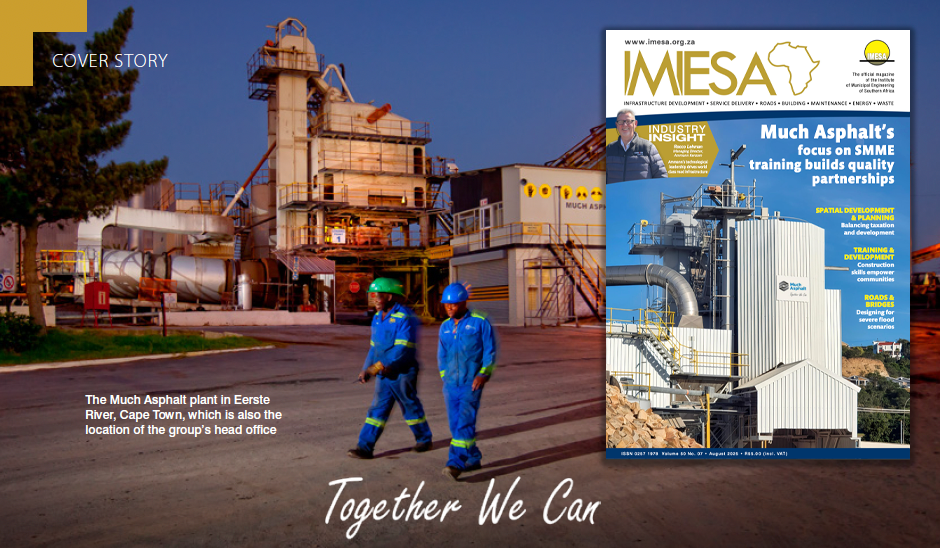
IMIESA Article August 2026 | Read full edition here
[Full text from article] HOW SUSTAINABLE IS THE ASPHALT INDUSTRY? IT’S ALL ABOUT THE PEOPLE.
Sustainability of the industry in which Much Asphalt operates is critical not only to the company’s future, but also to the country’s future. Much Asphalt is placing significant focus on securing that future in the interests of our economy and our communities, both heavily reliant on our asphalt road networks.
Much Asphalt is 61 years old this year. The company’s executive team brings a combined 282 years of industry experience to the business, an average of almost 18 years of service per member. This, alone, says something about the culture of loyalty and commitment that exists within Much Asphalt.
Managing change
Much Asphalt has adapted over its history to suit the needs of its customers. It has diversified with the acquisition of SprayPave, partnered with clients and other industry experts to improve products, expanded its footprint across South Africa, and launched operations in Mozambique and Namibia.
Sustainability requires innovation to deliver products that are purpose-designed for changing conditions and needs such as global warming, higher traffic volumes, different vehicles on the road, and a shortage of non-renewable resources.
Much Asphalt is known for its exploration of innovations, alone and in joint ventures with others across the globe, designed to improve safety, durability, and lifecycle value across road networks. These include experimenting with large volumes of recycled asphalt, as well as the use of waste glass, plastic and other recyclable materials, to replace virgin aggregates. It also includes studies and trials that seek to reduce the dependence on bitumen from crude oil.
Consistent quality
While change is essential, consistency remains equally important to provide sustainable solutions. A major contributor to Much Asphalt’s continuing success is the consistent quality achieved in the manufacture of its multiple products, which number more than 40 standard mixes and several specialty mixes. No matter which plant, quality and delivery to specification have always been non-negotiable.
Much Asphalt’s plants meet world class standards in production techniques, balanced by emissions control that significantly outperforms statutory requirements. Every plant has its own quality assurance laboratory, guided by the Cape Town based Central Laboratory that was the first asphalt lab in South Africa to receive SANAS accreditation.
Sustained quality leads to long-term customer partnerships and industry leadership.
Product sustainability for Much Asphalt extends from the manufacturing plant to the destination of the asphalt mix. It means ensuring quality from production to placement.
To this end, Much Asphalt has offered free training for government employees, SMMEs, and new entrants into the industry on the placement of asphalt by hand for more than 20 years. These individuals seldom have formal training in asphalt placement, resulting in poor workmanship and reputational damage to the industry.
Much Asphalt tries to close this gap through the hands-on training, which is accompanied by a step-by-step instruction manual.
Sustainability, for Much Asphalt and for the asphalt industry, depends on people.
People
Retaining the best staff within a company has a lot to do with a culture of loyalty, commitment, feeling valued, and working side-by-side with like-minded people. It also has to do with personal growth through continued learning and knowledge sharing.
Much Asphalt’s HR Executive, Tania Hendricks, explains that the company values teamwork, accountability, innovation and respect.
Employees are encouraged to share ideas, solve problems collaboratively, and continuously improve the way work is done. This creates an environment where people are trusted to contribute and where individual growth is aligned with business success.
“The organisation invests in leadership development, technical expertise, and succession planning because its future depends on the capability and commitment of its employees,” she says. “Much Asphalt has earned a reputation for empowering its teams through employee learning programmes, commitment to safety, and long-term career growth.”
In 2020, Much Asphalt invested in a dedicated training hub at its Cape Town head office to focus on internal training programmes that translate into operational excellence. It also serves as a platform to host industry lectures and knowledge sharing sessions for employees and industry partners.
How people succeed
Much Asphalt develops people outside and within the company for the future through graduate programmes, apprenticeships, internships, learnerships and structured training to build skills and progress careers.
“We achieve our greatest success when we combine practical, hands-on experience with structured mentorship,” says Hendricks. “The asphalt industry is highly specialised, and while classroom learning provides a strong foundation, it is through real-world exposure that young employees develop the confidence and technical competence to succeed.
“One of the company’s biggest strengths is giving young entrants the opportunity to work alongside experienced professionals. They learn directly from people who have spent their lives working with asphalt. This transfer of knowledge not only accelerates learning but also helps preserve the expertise that has been built within the business over decades.”
“The road construction sector relies on specialised skills that cannot simply be replaced overnight,” adds Joanne Muller, Group Technical Manager – Materials at Much Asphalt. “The industry’s most experienced professionals have spent years mastering the science of asphalt technology, manufacturing, laboratory testing, logistics and construction. Preserving this expertise requires deliberate investment in developing the next generation.”
Making asphalt interesting
Hendricks believes a sense of purpose is a powerful motivator and in the asphalt industry, no matter what your job, you can see the tangible results of your work in the infrastructure you use every day.
Giving asphalt the same appeal as other technical callings is not easy. But Much Asphalt has recognised a significant opportunity in engaging with young people who still have big career decisions to make.
“Most learners don’t know the industry exists or have misconceptions about it,” says Hendricks. “While road construction and asphalt manufacturing aren’t seen as innovative, technology-driven careers, that’s what they increasingly are.”
She believes more people can be drawn in by changing the narrative.
“Young people want to know why their work matters. We need to tell them not that we manufacture asphalt, but that we build the roads that connect communities, support businesses and keep South Africa moving.”
Today’s audience is largely online, she adds, and that’s where we have to share authentic content that showcases how modern technology is used in the industry.
This changes the perception from “manual labour” to “modern infrastructure”, she says.
By building relationships with schools, universities and colleges, Much Asphalt has established a direct line to learners, students, and graduates.
Students are far more likely to pursue careers they’ve experienced firsthand, and by offering plant visits, vacation work, job shadowing, scholarships and bursaries, Much Asphalt not only draws them into its facilities but plants the seeds that might keep them in the industry.
“Young people relate to peers more than corporate messaging, so we ask our graduates to attend the career fairs and expos to share their own experiences.”
People entering their careers also want to know that their employers are making good environmental choices. Saving the planet is becoming an increasingly urgent narrative, with good reason. “We have plenty to show in terms of asphalt recycling, lower-carbon technologies, energy efficiency, responsible manufacturing, and sustainable infrastructure,” Hendricks points out.
Ultimately, she says, the greatest success lies not simply in how many young people enter the programmes that Much Asphalt offers, but how many build rewarding, longterm careers at Much Asphalt. “We recruit on average 30 students every year through our learning programmes.”
Supporting our future
Roads connect people, enable economic growth and improve access to education and employment. By investing in young people, Much Asphalt is also supporting the future capability of the infrastructure sector that South Africa depends on.
New technologies, evolving environmental standards, digitalisation and changing customer expectations require fresh ideas alongside proven experience. Young professionals bring new perspectives, technological skills and innovative thinking that complement the knowledge of experienced teams.
“Much Asphalt’s comprehensive youth development initiatives reflect a simple philosophy,” says Hendricks. “The roads we build today support tomorrow’s communities and the people we develop today will build the roads and the businesses of tomorrow. By investing in young talent now, Much Asphalt is safeguarding its heritage and its future leadership in the asphalt industry.”
Women in asphalt
There are encouraging signs of greater female participation across both student programmes and the wider business. “More women are entering our graduate, internship and development programmes and we are seeing increasing representation across functions such as engineering, laboratories, SHEQ, operations, logistics and leadership.
“A diverse workforce brings different perspectives, stronger collaboration and better decision-making. Representation matters because it helps break down outdated perceptions about who belongs in the infrastructure sector,” Hendricks points out.
Industry initiatives
Last year Much Asphalt partnered with Go for Gold, an education-toemployment initiative founded in 1999 to address the shortage of technical skills in the construction and manufacturing industries. It supports talented youth from disadvantaged communities, bridging the gap from school to tertiary education and into permanent careers through mentoring and work experience.
Much Asphalt supports the programme by providing educational assistance to learners from Grades 10 to 12, offering workplace learning internships, and assisting with bursaries for further learning and graduate placements.
Much Asphalt also supports Masakh’iSizwe, a bursary programme started by the Western Cape Government in 2006 to bolster the numbers of trained professionals available in engineering and allied built environment fields. The programme awards external bursaries to disadvantaged learners for appropriate studies at higher education institutions in the Western Cape.
As a partner to the programme, Much Asphalt offers placement to the students to obtain industry experience.
“Our involvement in initiatives like these is essential to facilitate access to the road construction industry by all who use our roads,” says Eddie Jansen van Vuuren, Marketing and New Business Development Manager at Much Asphalt. “We hope to provide opportunities that will bring more passionate youngsters into the sector and spread the word across communities about the role of asphalt in keeping us connected.”
